
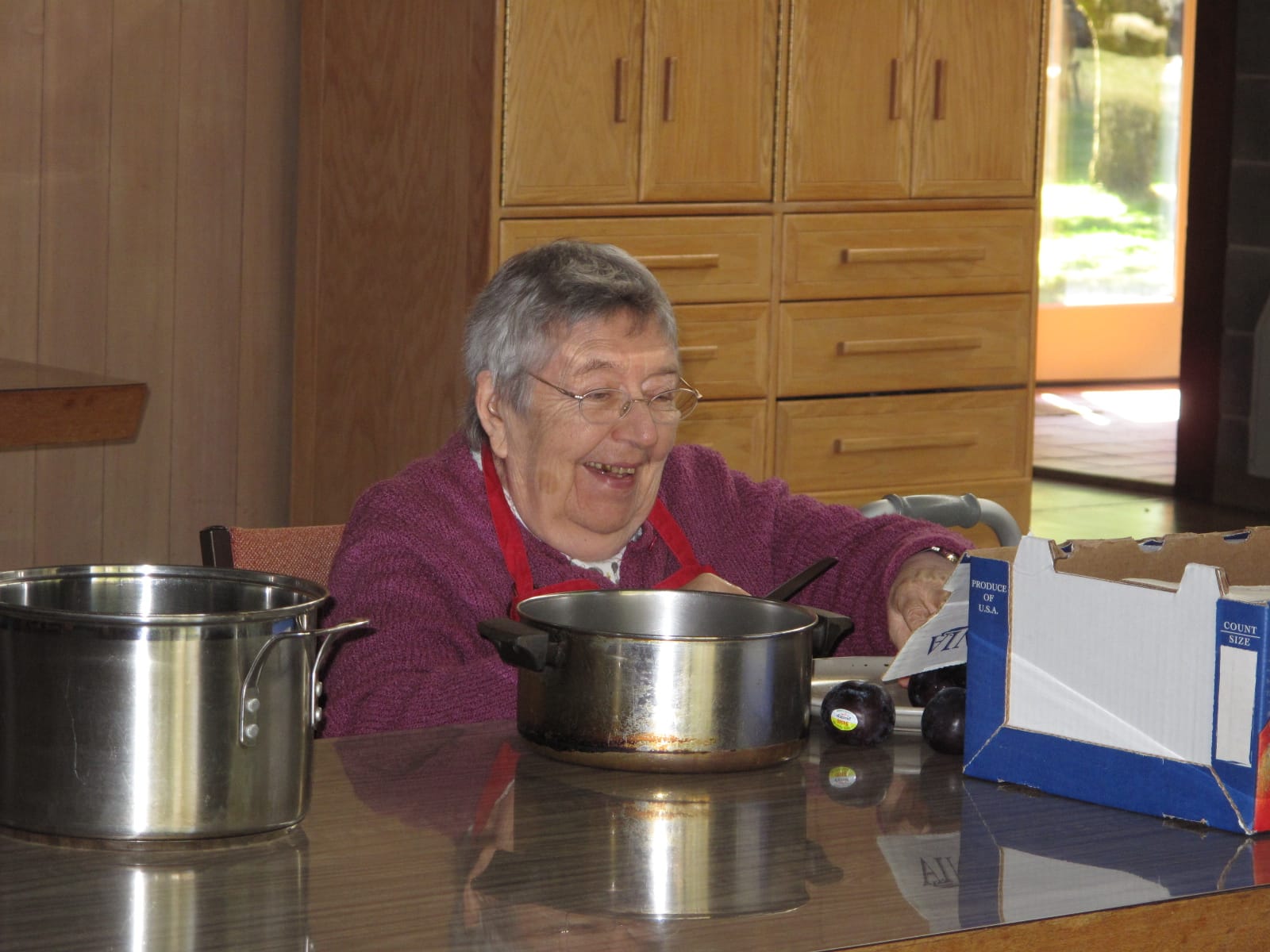
Thinking of our community life and our relationships, I pondered about the reality of service.
Saint Benedict at the end of the prologue of his Rule talks about “the service of the Lord” Prol 45”: “We have therefore to establish a school of the Lord’s service”. Benedict borrows the image and the words to the Master but quickly he softens what can be hard in the idea of schola and hopes to “establish nothing harsh or oppressive”. To be in a school is to learn. The learning is long; it asks to move on for years in a fundamental commitment. The disciple of Christ never finishes learning.
Without searching too much, I saw that in the RB there are 16 occurrences with the word service, 8 for “God”, 8 for the “brothers”, and 6 references of the word “servant”. It looks like it is for Benedict and so for us too, a key word to live our monastic life.
If we can say that our life is “learning Christ”, we need to go to him and understand what service means, what being servant means. Christ is the Servant of God, the one who calls us, saying, “Come to me and take my yoke which is light”. He is not only the Servant but God calls him “My Servant” and it is a title of honor: it unveils a deep and existential relationship, giving meaning to his life, to his mission. We are part of his mission, in our desire to follow him where he goes, like Thomas boldly affirms in the Gospel of John. Christ himself says that “he did not come to be served but to serve”.
Closer to us in her humanity, Mary also proclaims herself “I am the servant of the Lord”. She gives to herself this title. She dares to dialogue, to question the promise so that she can do it fully, in her freedom, sign of her dignity. She is a servant not losing her liberty and her dignity.
The path is not a smooth road; we know it and the apostles had to learn the true meaning of following Christ. In our Gospel of today, Peter learns it in a rough way. Jesus rebukes him with firmness. We can understand Peter’s reaction when crucifixion was in his time the worst way of dying that can happen. But more, Peter and we after him, are called not to be an obstacle for Christ but to think as God thinks, to accept the way of the Suffering Servant and to trust God who is leading our life and our world. Peter learned it, he who after Pentecost proclaimed: “God has made him Lord and Messiah, this Jesus whom you crucified”.
And so, our life of service takes another turn; far from being a work of slave, it is part of the mission of Christ, of the Redemption of the world. In the Christian tradition, the people of God participate in the work of God, in the mission of Christ by their acts and their words. It is what is asked of to us. Participants of the divine nature, participants of Christ’ s mission for the world by our services.
In the RB, Prol 45, “Service of the Lord” comes for the Latin “dominici schola servitii”.
The school of the seigneurial service. Dominici is an adjective; it is not a noun.
It is the service we give to the Lord but also it can be translated by service the Lord gives us.
There is service in the Trinity, because there are loving relationships. It is what we are called for;
Jn 17: 4: “I glorified you on earth by finishing the work that you gave me to do”.
So when our service seems to us, unjust, boring, when we compare our task to the others, when we drag ourselves to do something, when we are absorbed by our self-centeredness, let us remember that Christ came to serve and that we are part of his service, part of his love; it will lighten our burden, our tiredness and foster the Kingdom in our community, like Veronique uses to say.
I end with this saying of M Teresa who knew what service means:
“The fruit of love is service which is compassion in action.”
Sr. Claire Bouttin, Superior, Redwoods Abbey
(Chapter given for the 22nd Sunday OT A, August 30, 2026)
Jeremiah 20:7-9
Psalm 62 (63):2, 3-4, 5-6, 8-9
Romans 12:1-2
Matthew 16:21-27