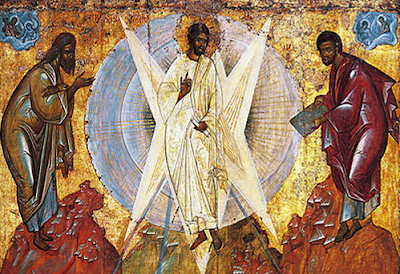
We are invited today to climb a high mountain with Jesus and the three disciples. We will meet 2 prophets who also like high mountains. It is there that these prophets had their revelation of the living God. This encounter with the God who frees his people was for them a turning point – an experience so deep that they could continue their mission for which God had sent them. Moses on the Mount Sinai received the Law, the Words of life. Elijah on the mount Horeb had the revelation of God with him.
Jesus is taking us also up on this high mountain today; we are the disciples who follow Jesus, with our fears, our lack of understanding and our expectations. Then the scene of the Transfiguration occurs. Three senses are involved, but above all is sight: his face and his clothes become as bright as the sun, shining like light. In a world of images, we know that what we see stays with us. It would have been a dazzling experience … Each one of us had this experience of a kind of “revelation” of God, something that is gratuitous, coming without us knowing it but opening for us an infinite horizon. Just starting with the call to monastic life; we did not create this call. This experience is precious and we should keep it as a treasure, in our journals but above all in our hearts.
But Jesus is walking towards his Passion; just before this passage, he warned his disciples of the sufferings waiting for him in Jerusalem and the necessity to take up our cross if we follow him. It seems the disciples needed to see the glory of God in advance to be able to endure the Passion of Christ, despite the horror and weakness of the One they thought would be their Savior.
The glory of Christ has been hidden in the Incarnation; now it is revealed in this Transfiguration. Jesus shows them and us the way to take towards the Resurrection. Transfiguration, metamorphosis, means “change of form”. The Letter to the Philippians asserts that Christ “who was in the form of God, emptied himself, taking the form of a slave…” Today we see the real form of Christ in his Transfiguration.
The term form should remind us of the Cistercian anthropology, dear to our founders. I am quoting Charles Dumont:
“The Eternal Wisdom incarnated herself in order to re-form the divine image that was damaged in us, in order to make it conform to her. Christ who is the forma , the form that our faces, our soul, our life have to take in, to be conformed to Christ and so to be restored in the image of Christ who is the image of God. This conformity itself is union with God.”
St Bernard says:
“I am united to Christ when I am conformed to him”. Unior cum conformor. (Song of Songs 71, 5. Cf 1 Cor 6: 17).
So, let us stay with Jesus, transfigured, to receive his glory and the strength to choose the path of his glory—and of our glory—knowing and believing that any suffering will be transformed. We hear Jesus saying to us, ‘Do not be afraid,’ and the voice coming from the cloud: ‘This is my beloved Son.’ Whatever happens, we are going toward the light, and all that we live will be transfigured.”
In the RB, the only reference for forma is ‘apostolicam formam” which occurs in chapter 2: 23: “In his teaching the abbot should always observe the Apostle’s recommendation, in which he says: ‘Use argument, appeal, reproach'” (2Tim 4: 2).
It would be better to translate ‘recommendation’ as the ‘model’ the Apostle set forth. This leads us again to the Christ-forma into which we are called to be transformed.
Sr. Claire Bouttin, Superior
Chapter Talk for the Second Sunday of Lent, Year A
March 1, 202
Lorem ipsum dolor sit amet, consectetur adipiscing elit. Ut elit tellus, luctus nec ullamcorper mattis, pulvinar dapibus leo.