
This Sunday is the Sunday of Divine Mercy. “It was established by Pope John Paul II in 2000, based on the visions of St. Faustina Kowalska. The central message is simple: God’s mercy is infinite, and it is offered to all who turn to Him in trust.” This Sunday is what we call a Sunday with a theme, and the liturgists react with the Sundays with themes: Trinity, Christ the King etc. as each Sunday is the expression of God’s mercy, of God Trinity etc.. (Popes are not good liturgists). We do not need a special feast to remind us that God is Father, Trinity, Mercy etc… Everyday reminds us of this. Each Eucharist reminds us of this.
The Latin word for mercy is misericordia, made from 2 words: misery, pain, distress and heart (cor, cordis). It covers two Hebrew words: hesed > fidelity, the one of the covenant and rahamim: the guts. Yes, God takes our misery in his heart, in his guts to raise us up. It is good news. From creation to the Cross, God puts himself at our level, to be face to face, like a friend talks to his friend; Like Moses and God in the book of Exodus (33:11). God is also the one who says in the book of Revelation: Rev 3: 20:
Listen! I am standing at the door, knocking; if you hear my voice and open the door, I will come in to you and eat with you, and you with me.
And it is up to us to open; Christ is at the door, a door we like to leave closed in our fears, in our righteousness, in our own way to see things, or in our refusal to move on. Christ is still knocking, with patience, with mercy, waiting for us to open, to transform the place of death into a place of freedom. A door open like the tomb on Easter morning, to let the Resurrection shine in us. Again, it is up to us, to each one of us to open our door to Christ, to let the Resurrection take place and take the whole place.
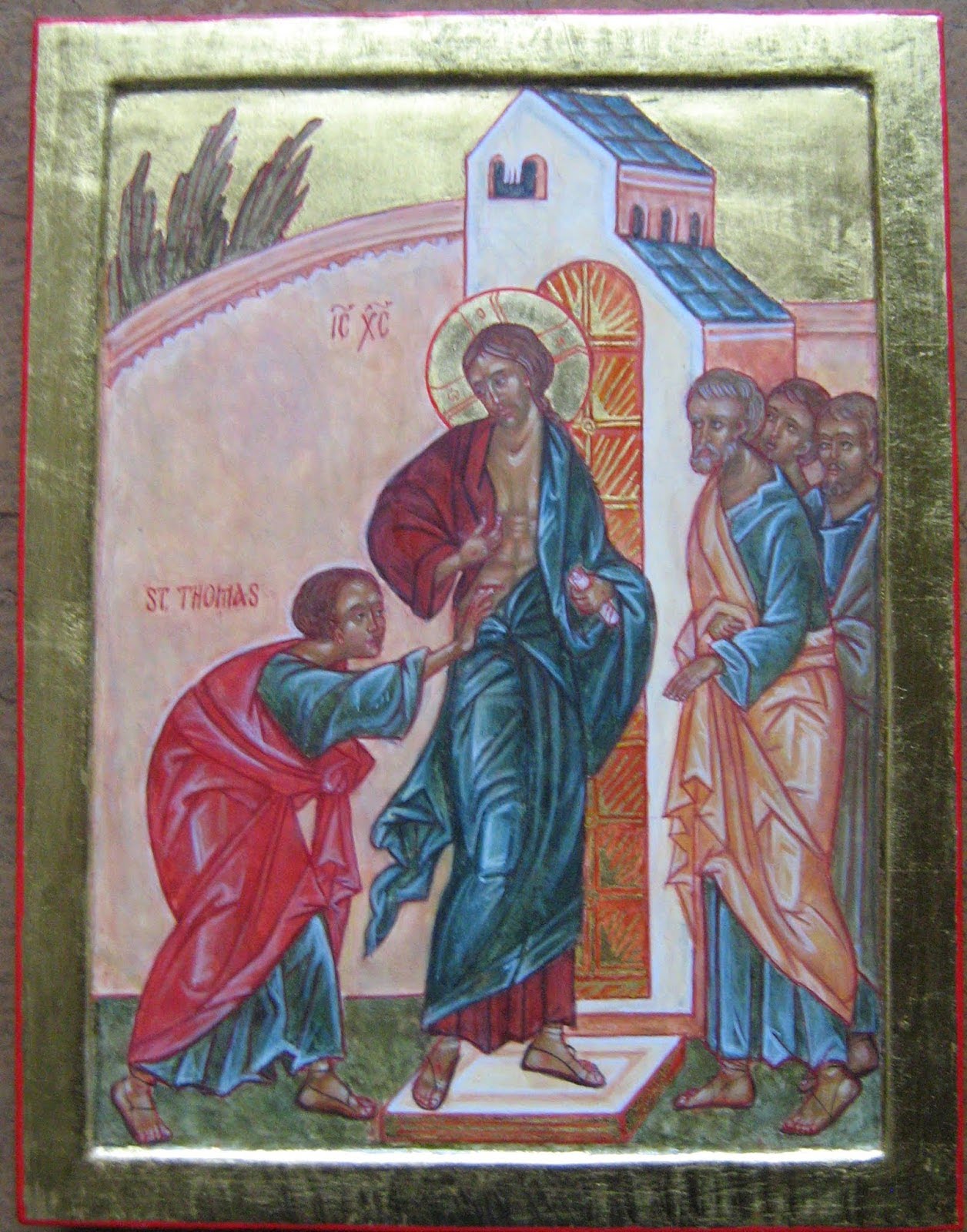
The apostle Thomas is a good illustration of this mercy that reaches each one, that reaches him today. Thomas expresses his doubt to the other apostles; this shows already that he is on the journey: open, trying to make sense of all events of the last week or last months. The other apostles had their doubts too: they did not believe the women nor the disciples of the road to Emmaus.
Jesus accepts Thomas’ resistance and leads him further. Thomas needs concrete support for his nascent faith. Jesus understands this; he takes Thomas where he is and guides him further in the Paschal Mystery: his wounds, his sufferings were the channel of the gift of the Holy Spirit and of his Resurrection. Jesus offers to Thomas to touch the reality of his Resurrection as he tells him: “Put your hand into my side”.
It is a spiritual Resurrection but also a sensual Resurrection that helps us to believe in the Resurrection of the flesh.
There is a tradition in Oriental Churches that says Jesus took the hand of Thomas and put it in his own side, to let him feel his heart beating, suffering and loving till the end of the world.
The icons took over this tradition, even some painters like Caravaggio. There is something deep in this tradition even if nobody describes the scene in the gospel. Thomas lets Jesus take his hand: he opens the door of his heart and leaves with us this beautiful confession of faith: “My Lord and my God!”. He welcomes Christ’s mercy and lets this mercy inhabit his life.
Now what will we do with this Sunday of Mercy, revealing to us the profound and unimaginable love of God for us?
Are we opening our door to Christ knowing that our life cannot be “without him”? It is what Jesus said to us: “not without you”. In our turn, we will turn to the other, our neighbor, the one who lives with us and says: “Not without you”. It is the fruit of God’s mercy: entering into the joy of God who is always present to us, God-with-us, and share the unexpected gift of his love with others.
Sr. Claire Bouttin, Superior
Second Sunday of Easter, April 12, 2026
(Acts 2: 42-27; Ps 117 (118) ; 1 Peter 1: 3-9; Jn 20: 19-31)
Note: The English word “mercy” originates from the Latin word “mercedem,” meaning “reward” or “wages,” which evolved into the Old French “merci,”meaning “kindness” or “grace.” The term has been used since the 12th century in English to refer to God’s forgiveness and compassion.