
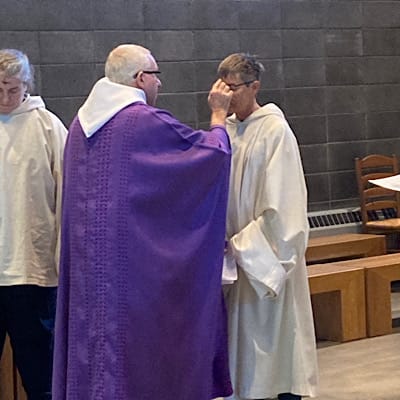
In his message for Lent, Pope Leo proposes to us to “undertake a shared journey during Lent”. Immediately Pope Leo situates this time offered to us as a time together, a shared journey. Not an isolated path, but a journey together, with the others. Or better said: “Not without the others” as it is the leitmotiv of the Church.
Lent, these structured 7 weeks before Easter, started in the 4th century, at first as a time of preparation for baptism (Nicea Council 325) and penance: reconciliation when penance was public. Lent is an ascent towards Easter, the feast of feasts, the victory of love on everything. There is one movement from Ash Wednesday to Pentecost, the fulfillment of Easter:
“The one who receives the ashes is the one who will receive the Holy Spirit at Pentecost”.
A single movement of living faith. Lent is part of it, as preparation. Let us keep in mind this kind of rainbow from Ash Wednesday to Pentecost, without breaking it.
On the first Sunday of Lent, the Church offers us the gospel of the temptations of Jesus. I will not make a commentary of this gospel as we will have the homily later.
Just some reflections:
Matthew and Luke present Jesus going to the desert, led by the Spirit (Matthew), or filled with the Spirit (Luke). Mark is more concrete: it is the Spirit who sends away Jesus in the desert. It is the verb used when a woman gives birth. The Holy Spirit “expels” Jesus as a woman “expels” her child. There is no better image of new life, new birth, new beginning. Jesus has been just baptized and heard the voice of the Father saying to all: “You are my beloved son”. This is his identity that will help him to hold on and resist the illusions Satan’s offers.
We too are beloved sons and daughters of the Father; for us too, it is our identity and this is the foundation of the spiritual journey we have taken. This voice of God is expressed by St Benedict in the Prologue of the Rule of Benedict: “What can be sweeter to us than this voice of the Lord inviting us, dearest brothers (carissimi)? Behold in his loving mercy the Lord shows us the way of life”. Prol 19.
The Pope offers some insights in this way of life:
Listening, because God the first listens to us; he hears the cry of his people.
Listening by taking the time to let the other express herself, without interrupting or staying in our own judgment, righteousness or stubbornness. Listening as if something new will appear. Listening as we need to make room for the unimaginable to come. Listening with the ear attuned to the Word of God, the Scriptures we open each day in our lectio.
Listen is also the first word of the RB.
Fasting: not putting our own will, egos, thoughts, way of doing things etc in front but again withdrawing in the secret of the heart to be accorded to the Word of God, to receive it, the Pope says.
Nothing is worth doing if it is not in harmony with this openness to receive this new life from God.
The Pope gives us a “very practical and frequently unappreciated form of abstinence: refraining from words that offend and hurt our neighbors”. This is a great idea to practice in our community, starting today.
I would like that we take this seriously, personally and together; it means:
- Refraining from commenting everything, everybody,
- Refraining from intervening when we are not invited in the conversation,
- Refraining rom reacting to everything, the little leaf dropped on the floor to what another sister does.
But above all, refraining from all those words, speeches or accusations, words with edge, which damage others, our relationships and the life of God in us. Christ was condemned by false witnesses, let us remember. We are responsible for what we say.
Let us not give power to our egos or our need to be right, to control or to have the power. With this attitude, the 3 temptations Christ are thwarted and we are grounded in his identity of the Beloved and put the Word of God before everything else.
To help us refrain from damaging words, 2 tips can help:
- At the end of the day, let us examine ourselves on all the talks of the day; and go for reconciliation if needed. Like Veronique who could not sleep in peace if something was on her heart.
- Moreover, let us ask ourselves: “What benefit do I gain to behave like this? How do I really want to live?”
To help us in this necessary conversion, let us remember that we too are beloved of God, that the other is beloved of God also and that it is our identity, our gift from God to share his love and eternity. Like Veronique.
I conclude with a text found in Veronique’s belongings:
“The first day after a death, the new absence
is always the same: we should be careful
of each other, we should be kind
While there is still time”
Philip Larkin.
Sr. Claire Bouttin, Superior
February 22, 2026, 1st Sunday of Lent A